
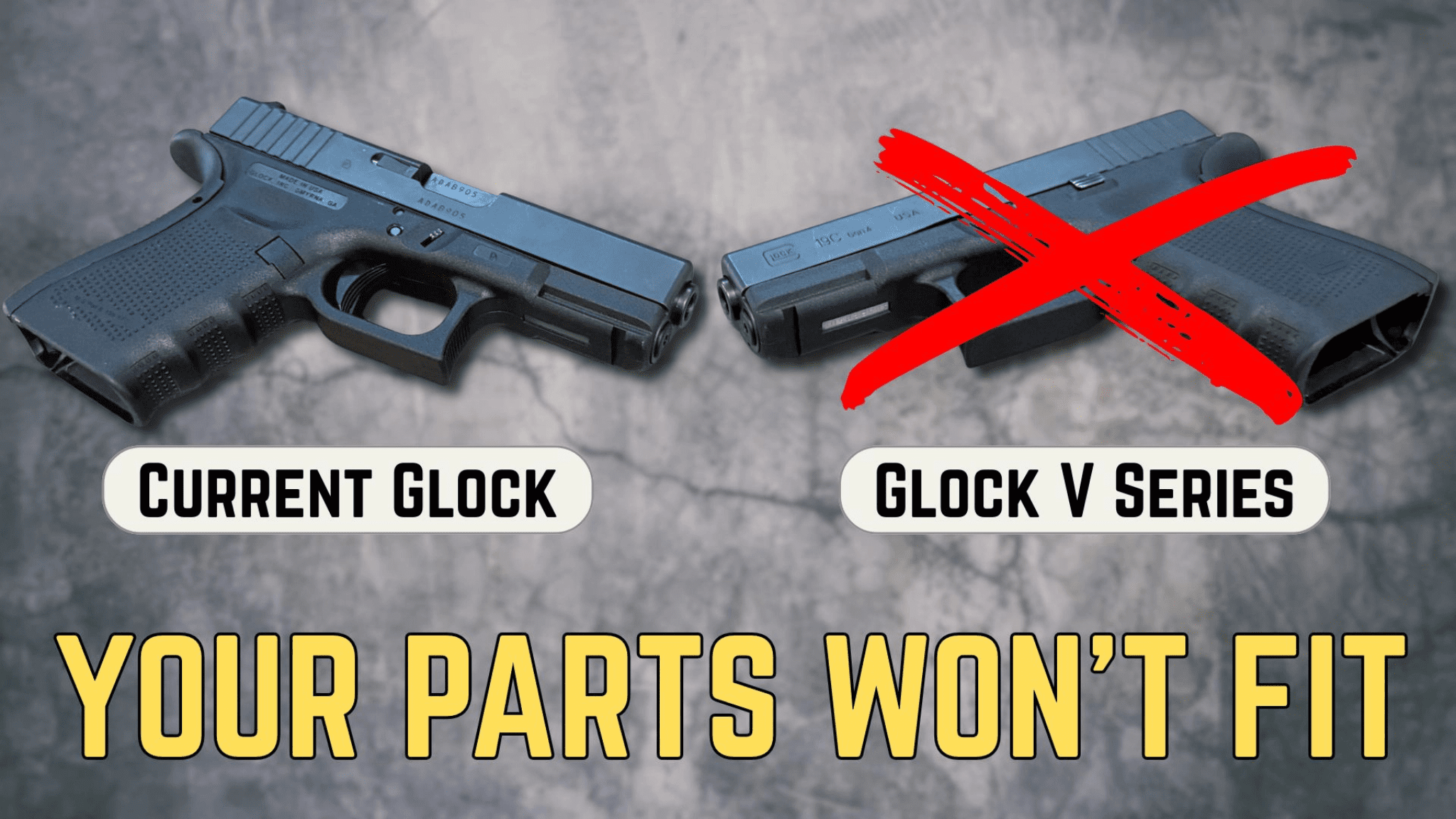
Glock is discontinuing a large number of commercial pistols — especially older Gen 3 and Gen 4 models and some low-demand calibers — and replacing that space in the lineup with a new “V Series.” The V guns are meant to look and feel like normal Glocks on the outside, at the same price point, but they use an updated internal mechanism. That internal change is widely understood to be Glock’s response to legal pressure around illegal “switch” devices and to state-level rules (like California’s AB 1127) that target pistols with older, more easily converted trigger layouts. Because the internals are changing, you should not assume your current aftermarket triggers and connectors will drop into the V guns. If you want a legacy configuration, buy from existing inventory; if you live in a restrictive state, it may make sense to wait and see how the V Series is treated.
Key takeaway: Glock is keeping the outside familiar and changing the inside to meet new legal realities. That protects their access to big markets, but it also means many older aftermarket parts may not work on new V guns.
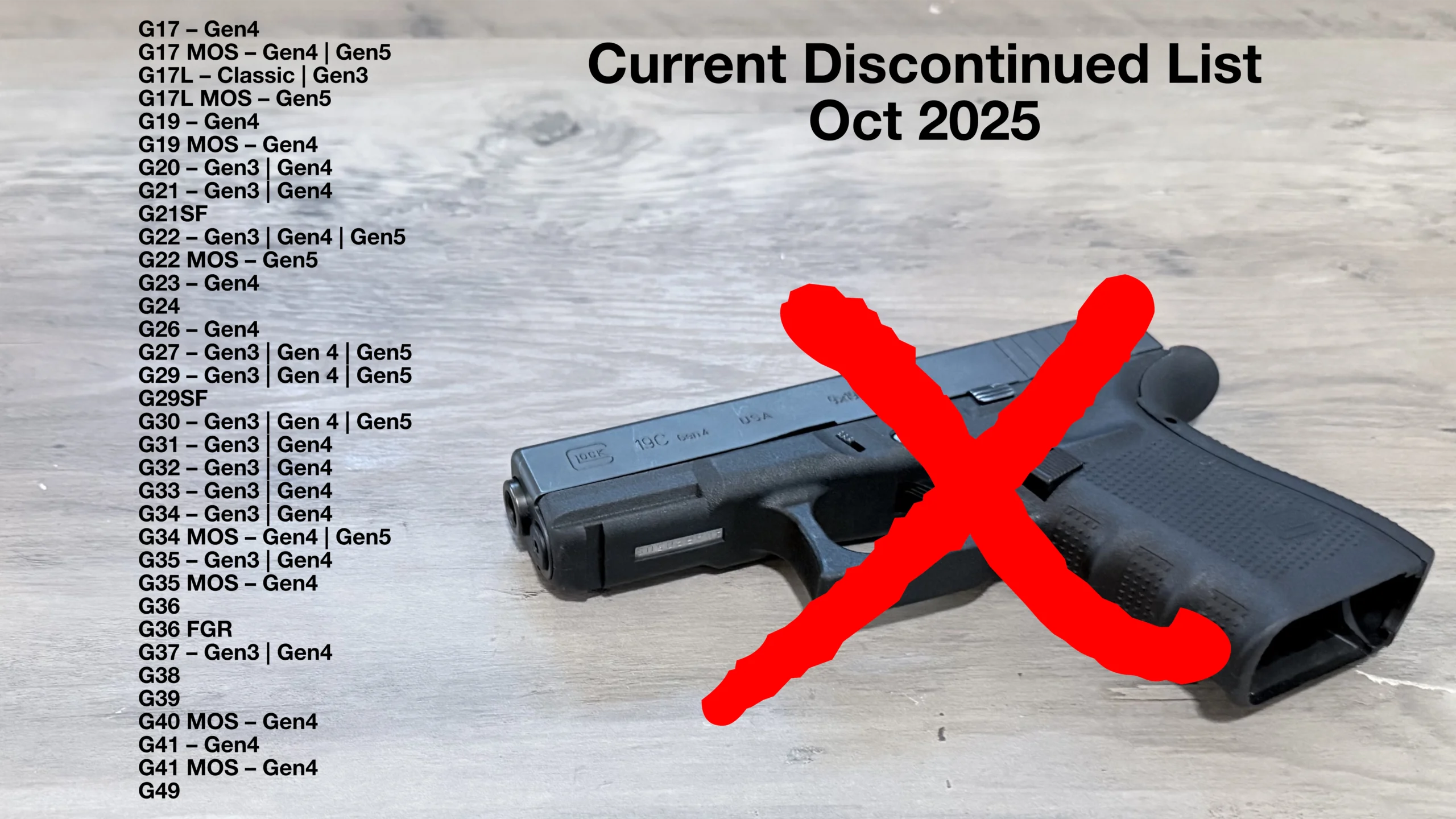
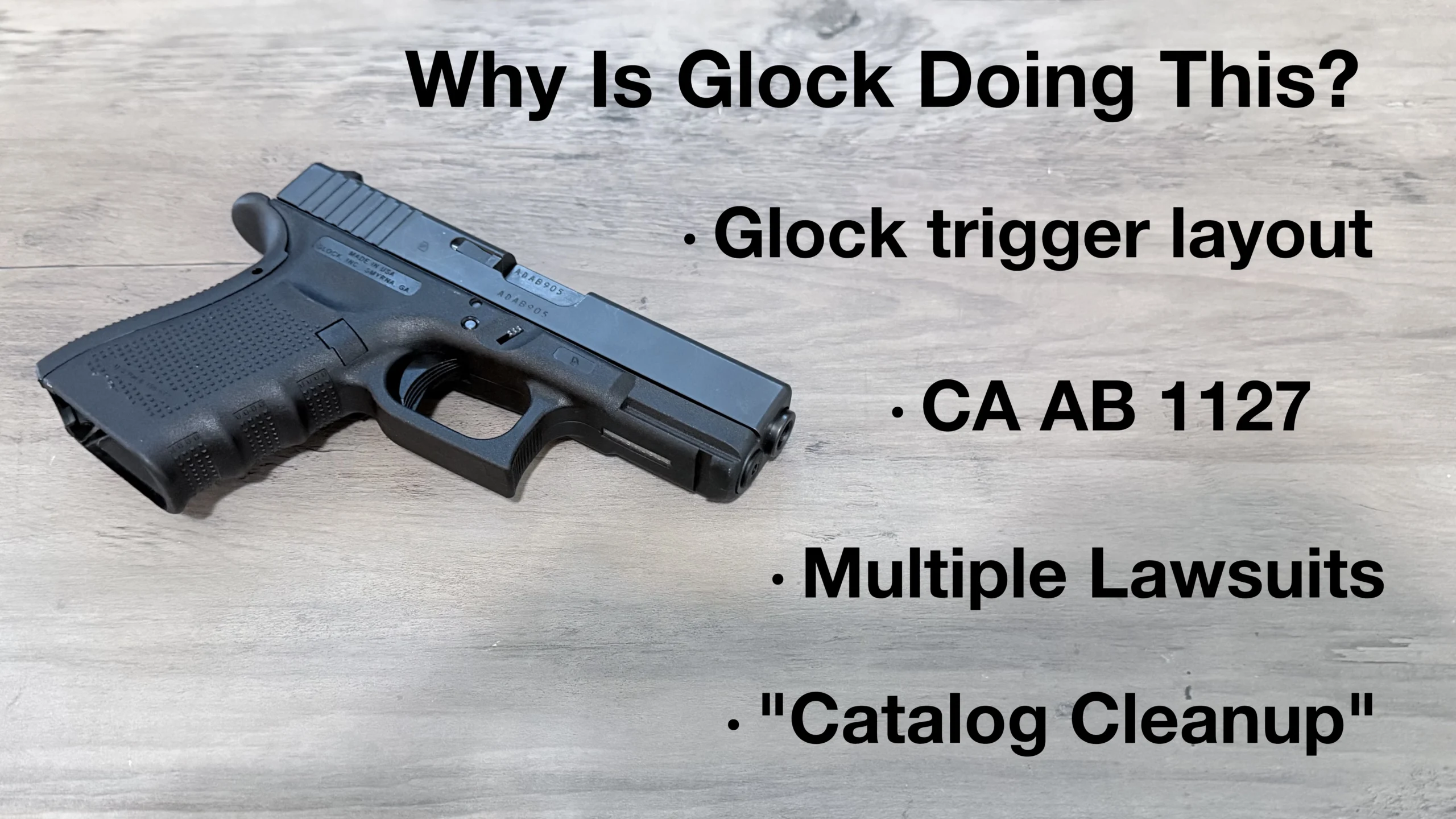
Glock didn’t wake up one day and decide to kill a bunch of Gen 3/Gen 4 guns for fun. They’re reacting to a very specific kind of pressure: states are saying, “Your pistols are too easy to turn into machine guns — redesign them,” and some of them are suing to force that change.
A Glock runs a partially cocked striker. When you pull the trigger, the trigger bar (with that classic Glock “cruciform” shape) travels rearward, lifts, and then drops off the firing pin lug to release the striker — that’s your normal semi-auto shot. An illegal Glock switch (a/k/a auto sear) snaps onto the back of the slide and adds a part that pushes the trigger bar down every cycle so the striker is released again immediately, without you letting the trigger reset fully. That’s how you go from semi-auto to 1,000+ rounds per minute with a $20 3D print.
So from a regulator’s point of view, the problem isn’t “Glock makes machine guns.” The problem is: the Glock trigger layout is exposed enough that a cheap, external part can interrupt it.
California’s AB 1127 (signed Oct 13, 2025) says: after July 1, 2026, dealers can’t sell a semiauto handgun that is “machinegun-convertible” — and the bill’s examples line up exactly with what a Glock switch does. It’s aimed at pistols that have trigger/striker interfaces that can be tripped or held down by an add-on. In other words, if your design leaves the trigger bar in a spot where an external device can grab it, California doesn’t want dealers selling it. desertsun.com+1
That puts Glock in a binary choice:
The V Series is Glock choosing California.
In 2025, New Jersey, Minnesota, and even Baltimore filed suits saying, basically, “Glock has known for years their handguns are uniquely easy to convert, they could have fixed the design, and because they didn’t, they should be liable.” The Minnesota AG’s release even says they want to compel Glock to make design changes that stop switches from working. Minnesota Attorney General’s Office+2Minnesota Attorney General’s Office+2
New Jersey’s case survived a motion to dismiss in October 2025 — the judge let it go forward on the theory that Glock could have made a less convertible design. That’s important legally, because it tells Glock: courts are at least willing to listen to “you should redesign it.” NJ.gov+1
So now imagine Glock’s legal department looking at all of that at once:
Best defense? Ship a version of the gun whose internals are not easily defeated by a backplate add-on — and make that the commercial model. That’s the V guns.
Yes, Glock’s catalog was bloated — all the Gen 3/Gen 4 overlap, oddball calibers, and SKUs that barely move. Cleaning that up saves money. But if this were just about SKUs, Glock could have sunset models quietly over 18–24 months.
They didn’t do that.
They’re doing a big, visible swap (lots of SKUs out, V models in) because:
1. Aftermarket parts:
Assume your current trigger/connector setup won’t work in a V gun until the parts makers say it will. This is the single most practical impact for everyday Glock owners.
2. Legacy pickup window:
If there’s a Gen 3/Gen 4 or specific caliber you really want — or you want to keep using a known, proven aftermarket trigger — get it now, from existing inventory, before dealers run out.
3. Restrictive states:
If you’re in California or another jurisdiction watching AB 1127-style rules, it can be smarter to wait and see if/when the V Series is cleared. Glock is clearly designing for that.
4. Everyone else:
You can just wait-and-see and let other people burn the first 5,000 rounds on the new design.
Who this is: longtime owner, maybe Gen3/Gen4, aftermarket trigger, maybe an extended mag release, maybe ported barrel.
Your guidance:
Why this matters: it tells your core guys they’re not “behind” if they stay legacy. That’s respectful.
Who this is: can only buy off a roster / heavily restricted list; cares about staying legal more than about aftermarket speed triggers.
Your guidance:
This is a totally different reader than your Arizona/Florida guy — write it like that.
Who this is: new buyer who picked Glock specifically for the parts ecosystem.
Your guidance:
This helps the confused shopper who doesn’t know the difference.
Who this is: your actual Everyday Gun Owner audience — 50+, carries to protect family, not a tinkerer.
Your guidance:
This is the voice that’s missing online — you can own it.
Who this is: the guy who other people will bring V guns to.
Your guidance:

Because Glock is trimming older generations and moving buyers toward newer, compliant internals. Maintaining multiple old generations costs more and creates legal friction in certain states.
It’s a set of Glock pistols that keep the Glock look/feel/price but use an updated internal firing/trigger layout, intended to satisfy newer regulatory expectations.
Glock has published a discontinued commercial pistols list. Many Gen 3 and Gen 4 models are on it, along with some slow-selling calibers. Readers should always check Glock’s current list.
It’s a pistol marked with a “V” (slide/frame) that uses the new internal design. Because of that change, many older aftermarket trigger/connector parts may not fit.
| Dave Pitcher, who’s been shooting and handling firearms since 1988. In addition, Dave’s served 12 years in the Army Reserve with deployments to Qatar and Afghanistan. This article is for educational purposes only and is not legal advice. Laws, rosters, and Glock’s discontinued list can change. Last updated: October 30, 2025. |
Join thousands of Everyday Gun Owners learning real-world preparedness, without the hype.
No spam. You can unsubscribe anytime.